A few years ago we worked on a retail development off the A64 where the client had bought a site that looked like flat grassland. Once we opened the first trial pit we found three metres of demolition rubble and ash over soft clay – the map showed it as undisturbed ground. That job taught us how deceptive Leeds can be. The city has a long industrial history, so large areas of Holbeck, Hunslet and the eastern fringes are underlain by made ground that nobody recorded properly. Our foundations on fill analysis starts with a thorough desk study of historical maps and borehole logs, then moves to intrusive investigation to measure the real behaviour of that buried material. We combine dynamic probing with MASW geophysical surveys to map variability across the site without drilling everywhere, and we always check the groundwater regime because fill can perch water in unexpected ways. The goal is to give you a clear, defensible bearing capacity and settlement prediction before you commit to a foundation design.
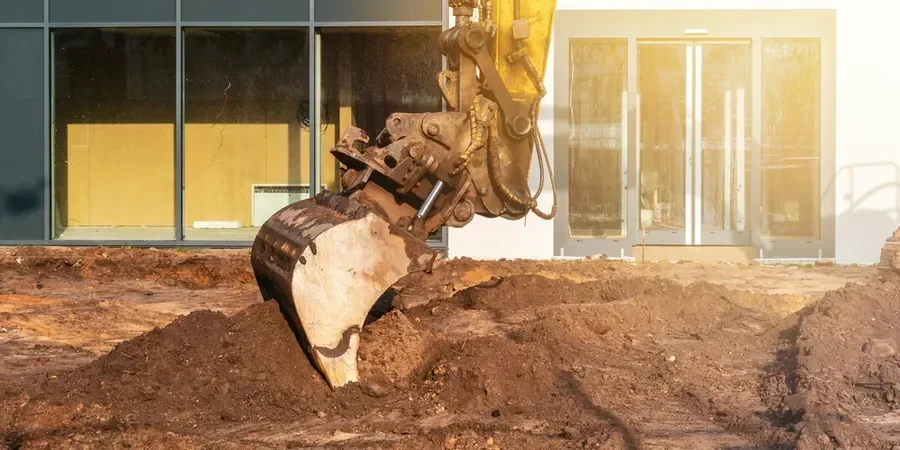
Made ground in Leeds is rarely uniform – trial pits on the same site can show brick rubble next to soft ash, so phased investigation is essential for reliable foundation design.
Scope of work in Leeds
Critical ground factors in Leeds
In Leeds, many developers assume that if the ground looks flat and has been there for decades, it must be stable. That assumption can be expensive. A common scenario is a housing plot on former railway land near the city centre: the fill looks like gravel but contains compressible ash layers that only show up under load. We have seen differential settlements of over 40 mm across a single terrace block because one end of the site had well-compacted ballast and the other had loose demolition waste. The real risk with foundations on fill in Leeds is not just total settlement – it is the unpredictable variation across the site. Without a targeted investigation that samples the fill at multiple points and depths, you cannot know where the soft spots are. That is why we always recommend a grid of dynamic probes or CPTs before designing strip footings or ground beams.
This service complements our laboratory testing work for a complete project analysis.
Our services
We offer three complementary solutions for foundations on fill analysis in Leeds, tailored to the site conditions and project stage.
Phase 1 – Desk Study & Walkover Survey
Historical map review and site reconnaissance to identify fill type, depth and contamination risks. Includes a preliminary foundation risk assessment.
Phase 2 – Intrusive Ground Investigation
Trial pits, windowless sampling, SPTs and CPTs to characterise the fill. On-site classification and in-situ density testing to supply design parameters.
Phase 3 – Bearing Capacity & Settlement Analysis
Calculation of allowable bearing pressures and predicted settlements using site-specific parameters. Includes sensitivity analysis for variable fill conditions.
FAQ
How do you test fill material that contains large rubble?
Standard SPTs can jam on brick fragments, so we use trial pits and dynamic probing (DPSH) in those layers. If the fill is deep we combine CPTs with a camera inspection of the probe hole to identify voids or soft lenses.
Can you build strip footings directly on fill in Leeds?
It depends on the fill type and thickness. Well-compacted granular fill with low variability can support strip footings, but we always require plate load tests at foundation level. For deeper or heterogeneous fills, we usually recommend ground beams or a reinforced raft.
What is the typical cost range for a foundations on fill analysis in Leeds?
A standard investigation for a residential plot (trial pits, SPTs and lab testing) ranges from £670 to £2,140 depending on the number of test points and the fill depth. Larger commercial sites with CPTs and plate load tests can be higher.
Do you check for contamination in made ground at the same time?
Yes, we routinely sample the fill for chemical testing (heavy metals, hydrocarbons, asbestos) as part of the investigation. Many Leeds sites on former industrial land require a combined geotechnical and geoenvironmental assessment.