Leeds sits on a mixed geology of Carboniferous Millstone Grit and Coal Measures, with glacial till and alluvial deposits along the Aire Valley. These layers vary sharply over short distances, creating distinct stability challenges for cut slopes and embankments. Our slope stability analysis in Leeds combines limit equilibrium and finite element methods to model failure surfaces under drained and undrained conditions. Before designing remediation, we recommend a drainage study to assess groundwater control, as pore pressure is often the trigger for shallow slides in the region's clay-rich tills.
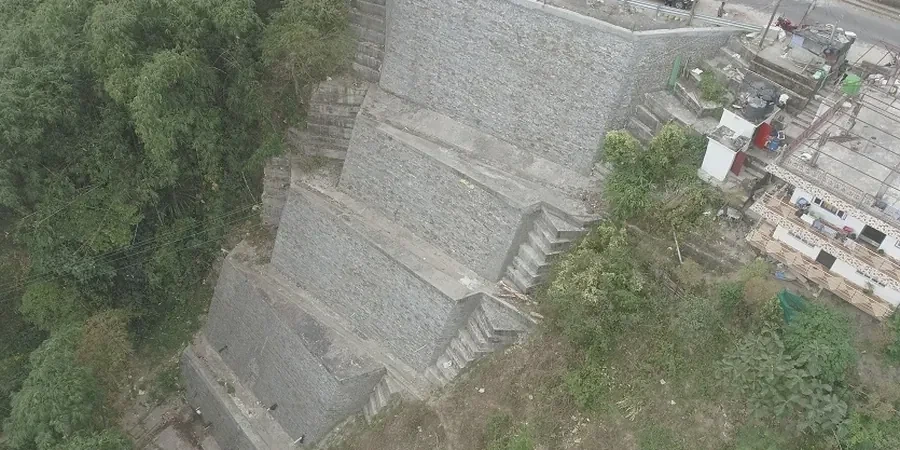
Pore pressure from winter rainfall is the single most common trigger for shallow slope failures in West Yorkshire's glacial tills.
Scope of work in Leeds
Critical ground factors in Leeds
In north Leeds, the steep-sided valleys of Meanwood and Adel feature strong sandstone bands over weak shales, where wedge failures can occur along joint planes. Conversely, the low-lying Holbeck and Hunslet areas have soft alluvial clays prone to creep and shallow translational slides. A slope stability analysis in Leeds must account for these local contrasts. Ignoring the effect of historical coal workings beneath Headingley can lead to sudden settlement and loss of toe support. We model both circular and non-circular surfaces to capture the full range of potential failure mechanisms.
This service complements our laboratory testing work for a complete project analysis.
Our services
We supply two complementary solutions for slope stability analysis in Leeds, each tailored to the project stage and complexity.
Limit Equilibrium Analysis (LEM)
For routine embankments and cuttings, we run 2D limit equilibrium with Bishop and Spencer methods. We model multiple slip surfaces, include tension cracks, and apply partial factors per Eurocode 7. Deliverables include FoS contours and cross-sections.
Finite Element Analysis (FEM)
For complex geometries or existing retaining walls, we use Plaxis 2D to simulate staged construction, pore pressure dissipation, and strain-softening behaviour. This captures progressive failure that LEM cannot model.
Watch how it works
FAQ
What is the recommended factor of safety for a permanent slope in Leeds?
Eurocode 7 recommends a minimum factor of safety of 1.3 for permanent slopes under drained conditions. For temporary excavations or flood embankments, a lower value of 1.2 may be acceptable. Our reports clearly state which partial factors have been applied.
How much does a slope stability analysis in Leeds cost?
A typical analysis for a single section with limit equilibrium modelling ranges from £990 to £1.850. If finite element modelling or multiple sections are required, the cost can reach £3.260. These figures exclude site investigation and laboratory testing.
Do I need a slope stability analysis for a small garden retaining wall?
Yes, if the retained height exceeds 1.5 m or the wall is near a public footpath or building. Small failures in Leeds' clay tills can propagate quickly. We can run a simplified analysis using characteristic strength values from a desk study to keep costs low.