Our field crew sets up hydraulic jacks and a steel loading platform directly on the soft alluvial clays common around Leeds. The setup includes settlement plates, piezometers, and inclinometers to track pore pressure dissipation. We apply the preload in stages, typically 25% of the design load per week, letting the ground consolidate between increments. This staged approach prevents sudden failure and matches the rate of strength gain in the underlying soils. For deeper deposits we combine this with vertical drains to shorten drainage paths and speed up consolidation. The whole rig runs on a geotextile separation layer to avoid mixing ballast with the soft subgrade.
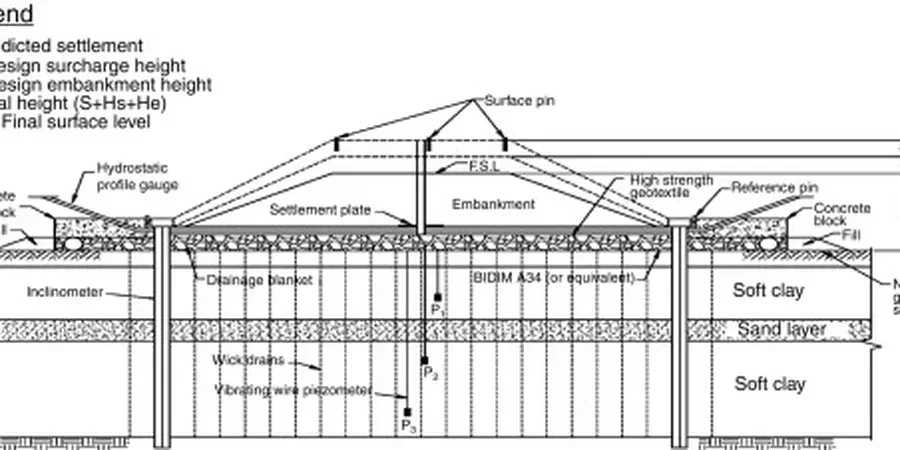
Staged preloading without surcharge relies on real-time pore pressure monitoring to match the loading rate to the soil's natural consolidation speed.
Scope of work in Leeds
Procedure video
Critical ground factors in Leeds
One risk we see frequently in Leeds is underestimating the secondary compression (creep) in glacial till and laminated clays. If the preload period is based only on primary consolidation, the structure may continue settling years after completion. To mitigate this we extend monitoring for at least two months beyond the predicted primary phase and apply a creep correction factor from the Casagrande log-time method. Another risk is lateral squeeze beneath the loaded area, which we control by limiting the load width to depth ratio and installing shear pins at the edges.
This service complements our laboratory testing work for a complete project analysis.
Our services
We offer two complementary approaches for preloading design in Leeds, tailored to site conditions and project timelines.
Staged Preloading Design with Settlement Monitoring
Full design of staged loading sequences, including instrumentation layout, data acquisition, and interpretation using Asaoka and hyperbolic methods. Includes weekly progress reports.
Consolidation Analysis and Oedometer Testing
Laboratory oedometer tests on undisturbed samples to determine cv, Cc, and creep index. Field verification with CPTu dissipation tests for comparison.
FAQ
How long does preloading without surcharge take in Leeds clays?
Typically 3 to 6 months for 85% primary consolidation in soft alluvial clays, depending on drainage path length and the coefficient of consolidation cv. Glacial till may require longer due to lower cv values.
What instrumentation is needed for preloading monitoring?
Minimum setup includes settlement plates, vibrating-wire piezometers at two depths, and inclinometers at the edge of the loaded area. For deep deposits we also install an extensometer to separate primary from secondary compression.
How much does a preloading design study cost in Leeds?
Between £590 and £1,840 for a typical residential or small commercial site, including field instrumentation, laboratory testing, and a consolidation analysis report. Larger sites with deeper clay layers may exceed this range.
Can preloading be combined with other Improvement methods?
Yes, vertical drains are commonly installed to accelerate drainage, and a temporary surcharge can be added if the schedule is tight. In soft peaty layers we also recommend a lightweight fill to reduce the net load.