Many construction firms in Leeds underestimate the lateral pressure from the region's glacial till and alluvial clays. A wall designed for generic soil parameters often cracks or tilts within months, especially when drainage is overlooked. That is why retaining wall design in Leeds must start with a proper ground investigation. Without site-specific shear strength and groundwater data, the wall's stability factor becomes guesswork. Combining lab triaxial tests with in-situ probing avoids costly failures. For sites near the River Aire or on the steep slopes of Headingley, this is non-negotiable. A thorough study of soil mechanics provides the foundation parameters needed for safe and economical wall geometry.
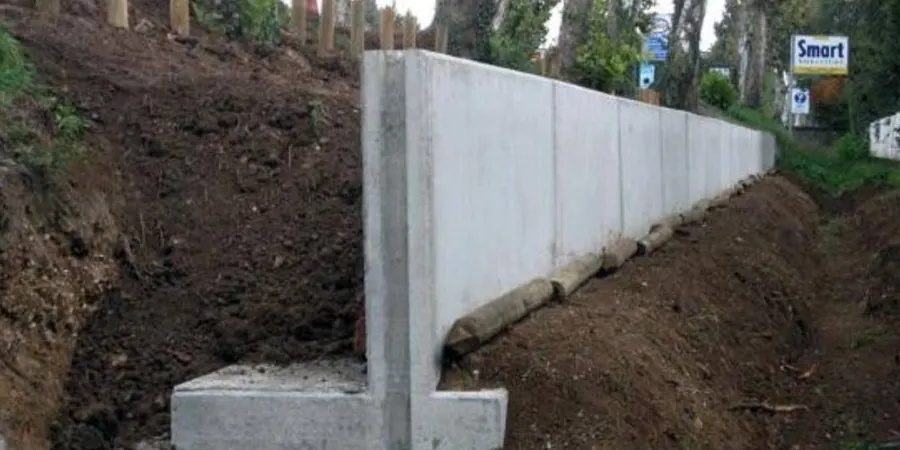
Glacial till and alluvial clays in Leeds generate lateral pressures that generic design codes do not capture without site-specific testing.
Scope of work in Leeds
Critical ground factors in Leeds
A gravity wall or cantilevered reinforced concrete section in Leeds must account for the low permeability of the local boulder clay. Water trapped behind the wall generates hydrostatic pressure that can exceed the earth pressure itself. We have seen basement walls in Chapeltown fail because the drainage blanket was omitted. The solution is a designed drainage system combined with a geotextile separator to prevent clogging. When the retained height exceeds 3 m, we recommend including a geotextile drainage composite behind the wall to relieve pore pressure and extend the structure's service life.
This service complements our laboratory testing work for a complete project analysis.
Our services
Our retaining wall design solutions in Leeds cover the full process from ground investigation to structural detailing.
Cantilever and gravity wall design
Reinforced concrete cantilever walls and mass gravity walls sized to resist overturning, sliding, and bearing failure. We use soil parameters from lab and field tests specific to the Leeds site, ensuring compliance with Eurocode 7.
Basement and embedded wall design
Secant pile walls, sheet piles, and contiguous bored pile walls for deep basements in Leeds city centre. Design includes wall embedment depth, propping levels, and groundwater control to meet UK building regulations.
FAQ
What is the typical cost of retaining wall design in Leeds?
For a standard residential retaining wall up to 2 m height, design fees range from £760 to £1,200. Larger commercial projects with embedded walls and groundwater control can reach £3,570. The final cost depends on site complexity and required testing.
Which soil types in Leeds most affect retaining wall design?
The dominant soils are glacial till (boulder clay) and river alluvium. Glacial till has high plasticity and low permeability, so it generates high active pressures and requires careful drainage. Alluvial deposits near the Aire are softer and may need Improvement before wall construction.
Do I need a full ground investigation before designing a retaining wall in Leeds?
Yes. Without boreholes or trial pits to measure soil strength and groundwater, you cannot reliably calculate wall stability. Eurocode 7 requires site-specific parameters.
How long does the design process take for a retaining wall in Leeds?
A simple cantilever wall design takes 2–4 weeks after receiving ground investigation data. Complex embedded walls with structural propping and groundwater modelling can take 6–8 weeks. Coordination with structural engineers and Leeds City Council building control adds time.
What is the minimum factor of safety for a retaining wall in Leeds?
Eurocode 7 requires a minimum factor of safety of 1.35 for ultimate limit state (sliding and bearing) and 1.5 for overturning. For serviceability limit state (wall rotation and settlement), we target a factor of 2.0. Higher factors apply to walls supporting critical infrastructure.