Leeds sits on a complex sequence of Coal Measures sedimentary bedrock overlain by glacial till, alluvial sands and river terrace gravels. For piled foundations in this city, we apply Eurocode 7 (EN 1997-1:2004) together with BS 5930 to separate shaft friction from base resistance. The millstone grit and sandstone bands common beneath Leeds city centre offer high end bearing potential, but the variable glacial till above often controls skin friction values. We run static load tests and interpret instrumented pile results to confirm the load-transfer mechanism. Before designing the pile group, we cross-check the soil profile using a CPT to capture continuous resistance data across the site.
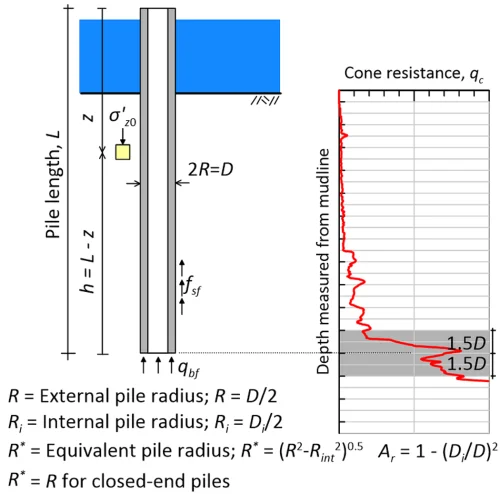
In Leeds, the Coal Measures sandstone can deliver end bearing values exceeding 5 MPa, but the overlying glacial till controls shaft friction and settlement behaviour.
Scope of work in Leeds
Critical ground factors in Leeds
The humid temperate climate of West Yorkshire keeps the water table high in the alluvial valley of the Aire. Saturated glacial till can soften during pile installation, reducing shaft friction by 20–40% compared to design values derived from dry samples. To counter this, we specify Osterberg cell tests or bi-directional load cells to isolate side resistance from base resistance directly. The risk of underestimating shaft friction in Leeds is real, especially in the laminated clay layers near the city centre where previous boreholes may have missed thin sand partings.
This service complements our laboratory testing work for a complete project analysis.
Our services
We cover the full range of pile analysis solutions in Leeds, from preliminary design parameters to verification testing on site.
Static Load Testing and Interpretation
Maintained-load and constant-rate-of-penetration tests on working and sacrificial piles. We separate skin friction from end bearing using strain gauges and tell-tale rods, then back-analyse the load-transfer curves for the specific Leeds ground profile.
Pile Design Parameter Review from Site Data
Review of SPT N-values, undrained shear strength from triaxial tests, and CPT cone resistance to assign unit shaft friction and base resistance values. We apply the local correlations developed from over 200 pile tests in the Yorkshire region.
FAQ
What is the difference between skin friction and end bearing in a pile?
Skin friction is the load carried by the side of the pile shaft through shear resistance with the surrounding soil. End bearing is the load transferred to the soil or rock at the pile base. In Leeds, piles in glacial till often rely mostly on skin friction, while piles tipped into Coal Measures sandstone mobilise significant end bearing.
When should I use Osterberg cell testing instead of a conventional static load test?
Osterberg cells are ideal when you need to isolate shaft resistance from base resistance in a single test, or when reaction loads from kentledge or anchor piles are impractical. In Leeds, we use them on sites with high water tables or where the pile toe reaches stiff sandstone and you want a direct base capacity measurement.
How much does pile skin friction vs. end bearing analysis cost in Leeds?
The analysis alone, including interpretation of one static load test and lab data review, ranges between £840 and £2,330 depending on pile diameter, number of instrumented levels, and whether you need a full design report. Site mobilisation and testing contractor costs are additional.
What geotechnical parameters are most critical for this analysis?
Undrained shear strength (su) for clay till, effective stress friction angle (φ') for cohesionless layers, and rock unconfined compressive strength (UCS) for sandstone. The stiffness profile from SPT N-values or CPT qc helps define the load-transfer curves. In Leeds, the ratio of su to N is typically 4–6 kPa per blow in glacial till.