Leeds sits on a varied geological mosaic: Carboniferous Millstone Grit underlies the western suburbs, while the eastern valleys are filled with glacial till and alluvial deposits from the River Aire. With over 800,000 residents and a booming construction sector, the city demands ground solutions that can handle both the stiff clay of Headingley and the compressible silts of the low-lying Holbeck area. Geocell design has become a go‑to technique here because it distributes loads evenly across weak subgrades without the need for deep excavation. We integrate this approach with a full study of soil mechanics to establish baseline strength and moisture conditions before any cellular confinement layout is finalised.
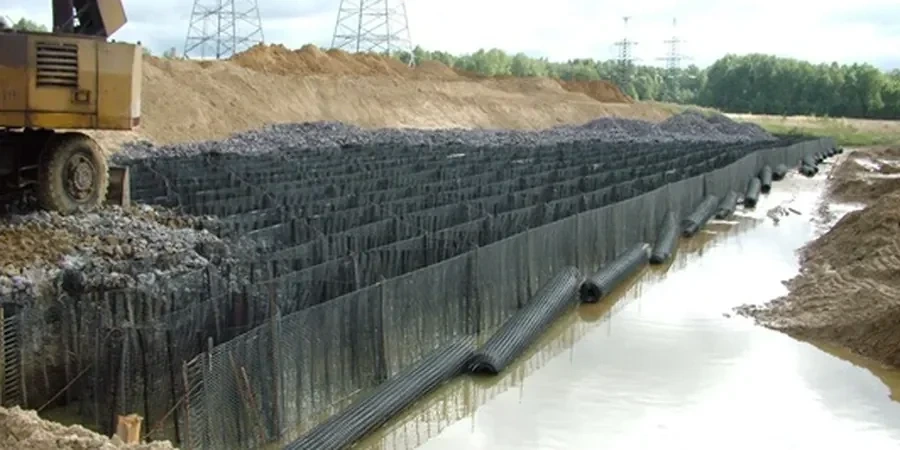
On the Holbeck brownfield corridor, geocell design reduced required sub‑base thickness by 40 % compared to traditional granular capping.
Scope of work in Leeds
Critical ground factors in Leeds
In Leeds we frequently see projects where geocell is specified without checking the underlying drainage regime. If a cell mattress sits on a silty subgrade that stays saturated for weeks, pore pressures build and the confinement effect drops off sharply. Another local pitfall is assuming a single infill works for both trafficked and non‑trafficked areas – the angularity and compaction of the fill directly control the composite modulus. We always run a plate load test on a trial panel before full production, and we recommend reviewing the subgrade reaction modulus alongside the cellular design to avoid unexpected rutting in the first winter.
This service complements our laboratory testing work for a complete project analysis.
Our services
Our geocell design service covers the full cycle – from site characterisation and cell selection through to installation support and QA testing. We work with tier‑1 contractors and specialist civils firms across West Yorkshire.
Geocell Bearing Capacity Analysis
We calculate the composite stiffness of the confined soil‑geocell system using the method of Bathurst & Karpurapu (1993) calibrated against local Leeds ground conditions. Output includes allowable bearing pressure, elastic settlement and a certified design report compliant with Eurocode 7. Ideal for temporary haul roads and permanent embankments on soft ground.
Geocell Slope & Retaining Wall Design
For slope stabilisation and gravity walls up to 4 m high, we design geocell wraps with integral facing. Each tier is checked for internal sliding, overturning and global stability using Bishop’s simplified method. We incorporate drainage layers and vegetation pockets where required by planning conditions.
FAQ
How does geocell design differ from conventional granular capping on Leeds soils?
Conventional capping relies on a thick layer of imported granular material to spread the load; geocell confinement mobilises lateral restraint in the fill, allowing a 30–50 % reduction in layer thickness. On the glacial tills of north Leeds, this can cut import volumes significantly while still achieving a CBR of 8–12 % at the sub‑base interface.
What is the typical cost range for a geocell design package in Leeds?
A full design package, including site‑specific bearing analysis, cell selection and a construction drawing set, typically ranges from £720 to £2,040 depending on the area treated and the number of load cases. This excludes laboratory testing of infill material.
Can geocell be used on the steep slopes of the Aire Valley?
Yes, and it is increasingly common. On slopes steeper than 1V:2H we design terraced geocell layers with a geogrid anchor at the base. The key is to verify the internal friction angle of the infill and the interface shear between cells and the underlying soil – we always run a direct shear test on the interface before finalising the design.
What quality control do you recommend during installation?
We recommend a trial panel at least 5 m x 5 m with a plate load test (300 mm diameter, 1.5 times working load) to confirm the composite modulus. Ongoing QC includes checking cell weld strength every 500 m² and verifying infill compaction to 95 % of maximum dry density (BS 1377‑4).