A common mistake we see on Leeds construction sites is assuming the glacial till that underlies most of the city behaves uniformly. It does not. The till here is a complex mix of stiff clays, sands, gravels and occasional boulders, deposited during the last ice age, and its engineering properties can vary dramatically over just a few metres. Skipping a proper soil mechanics study often leads to underestimating settlement potential or overestimating bearing capacity. For any project in Leeds, from a basement extension in Headingley to a commercial block near the station, we always recommend combining a soil mechanics study with a classification of soils to identify the exact material encountered and a density test with sand cone for compaction control on site.
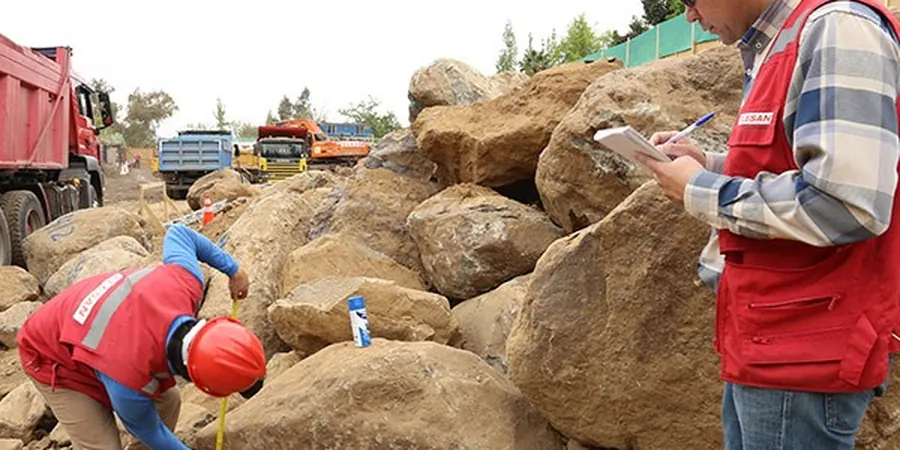
Glacial till in Leeds is not uniform: stiffness and plasticity can change within metres, making a site-specific soil mechanics study indispensable.
Scope of work in Leeds
Critical ground factors in Leeds
Leeds sits about 63 metres above sea level on average, but the topography varies widely from the river Aire valley up to the Pennine foothills. The main geotechnical risk we see is differential settlement on clay sites where one part of the building is on stiff till and another on softer alluvium or made ground. Without a soil mechanics study that covers both field and lab phases, that risk is invisible until cracks appear. We typically run a phased investigation: trial pits or boreholes first, then targeted laboratory work to confirm the design parameters before foundation design.
This service complements our laboratory testing work for a complete project analysis.
Our services
We deliver a complete soil mechanics study package for Leeds, from field exploration to certified lab results.
Field Investigation & Sampling
Rotary boreholes and windowless sampling in Leeds till and alluvium, with SPT testing every metre and undisturbed tube samples for lab testing. We log strata according to BS 5930 and supply daily progress reports to the client.
Laboratory Testing & Reporting
UKAS-accredited lab work including triaxial compression, consolidation, Atterberg limits, particle size distribution and chemical testing for sulphate and pH. All results are delivered in a factual report with certified test certificates and interpreted design parameters.
FAQ
Why is a soil mechanics study necessary for a house extension in Leeds?
Leeds has highly variable glacial till and alluvial soils along the Aire valley. Without testing, you risk differential settlement of the new extension relative to the existing house, which can cause cracking and structural damage. A study identifies the soil type, strength and shrinkage potential so the foundation design matches the actual ground.
How much does a soil mechanics study cost in Leeds?
For a typical residential project in Leeds, expect a range between £2.400 and £4.260 depending on the number of boreholes, depth required and the extent of laboratory testing. Larger commercial sites with deeper boreholes and more complex testing will be at the upper end of that range.
What standards apply to soil mechanics studies in the UK?
The main code is BS 5930:2015 for ground investigation procedures, together with Eurocode 7 (BS EN 1997-1:2004) for geotechnical design. Laboratory tests follow British Standard methods or ASTM equivalents. Our lab operates under UKAS accreditation to ensure compliance with all relevant standards.
How long does a soil mechanics study take from start to finish?
A straightforward residential study in Leeds typically takes 2 to 3 weeks: one week for fieldwork (drilling and sampling), one week for lab testing, and a few days for reporting. Complex sites with multiple boreholes or advanced lab work may extend to 4 or 5 weeks.
Can a soil mechanics study identify contaminated ground in Leeds?
Yes, if we include chemical testing in the scope. The glacial till in Leeds is generally clean, but made ground on former industrial sites (common around the city centre and Holbeck) can contain hydrocarbons, heavy metals or sulfates. We test for pH, sulphate, chloride and organic content as part of a standard suite, and can add VOC/SVOC analysis if required.