Ground improvement in Leeds represents a strategic discipline within geotechnical engineering, encompassing a suite of techniques designed to enhance the engineering properties of soils and rocks. As the city undergoes significant regeneration and infrastructure expansion, from the South Bank Leeds development to major transport corridors, the need to build safely on marginal or problematic ground has never been greater. This category brings together specialist design and specification solutions that allow developers and contractors to transform weak, compressible, or otherwise unsuitable soils into reliable founding strata. By addressing challenges at the ground level, these interventions reduce long-term settlement risks, improve bearing capacity, and enable construction on sites that might otherwise require prohibitively expensive deep foundations. The solutions covered here span mechanical mixing, drainage acceleration, preloading strategies, reinforcement specification, and performance monitoring, each tailored to the specific ground conditions encountered across the Leeds metropolitan area.
The underlying geology of Leeds presents a varied and often demanding profile for construction. Much of the city centre and the Aire Valley is underlain by superficial deposits of alluvium, glacial till, and laminated clays, which can be soft, highly compressible, and prone to differential settlement. These Quaternary sediments sit above the Carboniferous Coal Measures, comprising interbedded sandstones, siltstones, and mudstones, which themselves can present variability in strength and weathering depth. In areas such as the Lower Aire Valley and former industrial zones, made ground and historical fill add further complexity, often containing obstructions or contaminated materials. These conditions demand a rigorous understanding of local ground behaviour, as standard foundation solutions may be inadequate. Ground improvement techniques must be carefully selected to match the specific stratigraphy, with prefabricated vertical drain (PVD) design proving particularly effective for accelerating consolidation in the soft clays found along the river corridors.
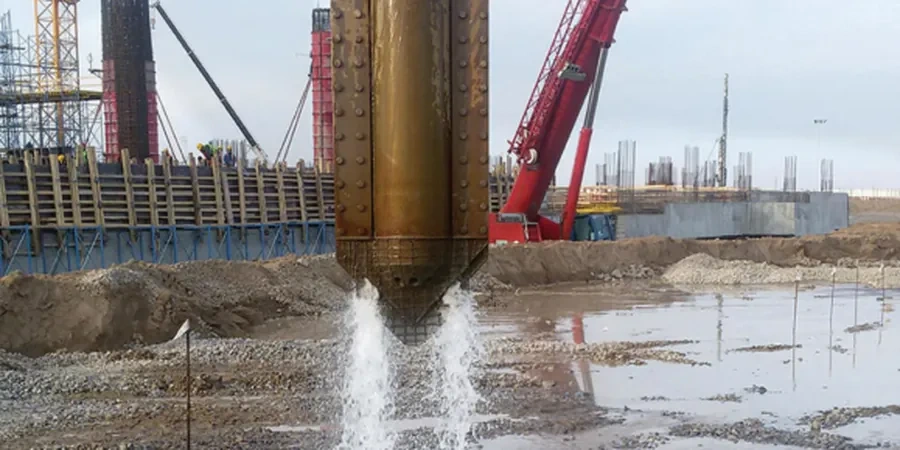
All ground improvement works in the UK must comply with the overarching framework of Eurocode 7 (Geotechnical design), specifically BS EN 1997-1:2004+A1:2013 and its UK National Annex, which sets out the principles for geotechnical design and the selection of design approaches. For execution, BS EN 14475:2006 governs the construction of special geotechnical works, including reinforced fill and ground improvement by deep vibration and mixing. The specification for ground treatment is further detailed in the ICE Specification for Ground Treatment, which remains a key contractual document for UK projects. Compliance with the Construction (Design and Management) Regulations 2015 (CDM 2015) is mandatory, placing duties on designers to eliminate or reduce risks during construction and throughout the structure's life. Environmental permitting and waste management regulations, enforced by the Environment Agency, may also apply when dealing with contaminated soils or in-situ treatment methods like Deep Soil Mixing (DSM) design, where binders are introduced into the ground.
The types of projects in Leeds that routinely demand ground improvement are diverse. Large-scale commercial and residential developments on brownfield land, such as those within the South Bank regeneration area, frequently encounter soft alluvial soils requiring preloading or vertical drains to manage settlement within acceptable timeframes. Infrastructure schemes, including highway widening on the M621 and new rail freight interchanges, rely on preloading design (without surcharge) to improve ground without the logistical burden of importing fill. Industrial facilities with heavily loaded slabs or storage tanks benefit from DSM to create stiff, homogeneous blocks that limit differential movement. For projects involving reinforced soil structures or separation layers beneath embankments, precise geotextile specification ensures long-term durability and filtration performance. Across all these applications, geotechnical instrumentation (design and installation) plays a critical role in validating design assumptions and confirming that improvement targets are being met during and after treatment.
FAQ
What ground conditions in Leeds typically require improvement?
In Leeds, improvement is commonly needed for soft alluvial clays and silts along the River Aire floodplain, loose or variable made ground in former industrial areas, and glacial till with pockets of soft material. These soils often exhibit low bearing capacity and high compressibility, leading to unacceptable total and differential settlement under structural loads. A thorough ground investigation is essential to characterise the depth and extent of these problematic layers.
When is ground improvement a better option than deep piling?
Ground improvement becomes preferable when the problematic soils are relatively shallow, typically within 10 to 15 metres of the surface, and the proposed structure can tolerate a uniform settlement profile. It often provides a more cost-effective and faster solution for treating large areas, such as under floor slabs or embankments, eliminating the need for extensive pile caps and ground beams. The choice depends on a comparative assessment of programme, cost, and long-term performance.
How does the UK regulatory framework influence ground improvement design?
Design must comply with Eurocode 7 (BS EN 1997-1) and its UK National Annex, which mandate a limit state design philosophy and the use of partial factors for soil parameters and resistances. Execution standards like BS EN 14475 govern construction methods, while CDM 2015 imposes legal duties on designers to manage health and safety risks. The ICE Specification for Ground Treatment is commonly adopted as the contractual quality control document.
What is the role of monitoring during and after ground improvement works?
Monitoring is critical to validate design assumptions and confirm that the improvement technique is achieving the specified performance criteria. Instrumentation such as settlement plates, piezometers, and inclinometers provides real-time data on consolidation rates, pore water pressure dissipation, and lateral displacement. This data allows for informed decisions on programme adjustments and provides assurance to stakeholders that the treated ground will perform as predicted.