Seismic engineering in Leeds addresses the critical need to design and assess structures for earthquake resilience, despite the United Kingdom's relatively low-to-moderate seismicity. This category encompasses a comprehensive suite of solutions aimed at mitigating seismic risk across new developments, heritage retrofits, and infrastructure projects. While the UK does not sit on active plate boundaries, intraplate earthquakes—such as the 2008 Market Rasen event felt across Yorkshire—underscore the importance of preparedness. For a city like Leeds, with its dense urban fabric, historic Victorian architecture, and ambitious regeneration schemes, integrating seismic considerations ensures life safety, asset protection, and business continuity.
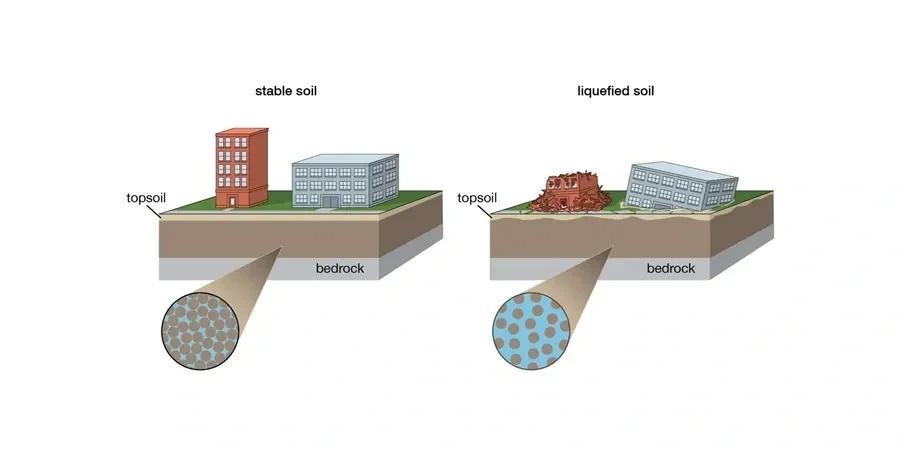
The geological context of Leeds is dominated by Carboniferous Coal Measures, comprising interbedded sandstones, mudstones, and coal seams, overlain in parts by glacial till and alluvial deposits along the River Aire. These superficial deposits can amplify ground motion and are susceptible to phenomena such as soil liquefaction, where saturated granular soils lose strength under cyclic loading. Our soil liquefaction analysis service is specifically tailored to evaluate these risks, providing essential data for foundation design in riverside postcodes like LS10 and LS11. Additionally, the variable bedrock depth across the district—from outcropping millstone grit in the north to deeper drift-filled valleys in the south—demands site-specific seismic hazard assessments.
UK seismic design is principally governed by Eurocode 8 (BS EN 1998), which provides a framework for seismic actions and detailing requirements, adapted through the UK National Annex. Although Leeds is classified as a low-seismicity region, certain structures—particularly those in Importance Class III and IV, such as hospitals, emergency solutions hubs, and major transport interchanges—must comply with ductility and capacity design rules. The British Geological Survey's seismic hazard maps inform peak ground acceleration values, while local planning authorities may require seismic assessments for tall buildings or those with irregular configurations. Base isolation seismic design often becomes the preferred solution for critical facilities, decoupling the superstructure from ground motion and significantly reducing lateral forces.
This category serves a broad spectrum of projects, from the seismic retrofit of Leeds' cherished Victorian mills and arcades to the design of new student accommodation towers in the city centre. Infrastructure schemes, including upgrades to Leeds Station and the proposed mass transit network, demand rigorous seismic analysis to maintain operational resilience. Industrial facilities handling hazardous materials, data centres, and healthcare buildings—such as the Leeds General Infirmary—are prime candidates for advanced seismic engineering, where performance-based design goes beyond code minimums. By embedding seismic resilience early, developers can avoid costly remediation and align with the UK's commitment to disaster risk reduction under the Sendai Framework.
FAQ
Why is seismic design necessary in Leeds given the UK's low earthquake risk?
Although the UK experiences infrequent earthquakes, historical events like the 2008 Market Rasen tremor demonstrate that moderate shaking can occur. Leeds' dense urban environment, aging building stock, and alluvial soils near the River Aire can amplify ground motion. Eurocode 8 mandates seismic assessments for critical structures, ensuring public safety and preventing disproportionate damage even from low-probability events.
What geological factors in Leeds influence seismic hazard assessments?
Leeds sits on Carboniferous Coal Measures with variable superficial deposits including glacial till and river alluvium. These soft soils can amplify seismic waves and are prone to liquefaction in water-saturated zones. Bedrock depth varies significantly across the city, requiring site-specific ground investigations to determine shear wave velocity profiles and local site amplification factors per BS EN 1998.
Which types of buildings in Leeds typically require seismic analysis under UK regulations?
Structures in Importance Class III and IV under Eurocode 8 require seismic analysis, including hospitals, emergency response centres, major transport hubs, and buildings with high occupancy. Tall or irregular structures, heritage retrofits, and facilities storing hazardous substances also commonly undergo seismic design, even outside formal mandates, to manage risk and satisfy insurers.
How does base isolation compare to conventional seismic design for Leeds projects?
Base isolation decouples a structure from ground motion using flexible bearings, drastically reducing accelerations and inter-story drifts compared to conventional ductility-based approaches. It is particularly suited for critical facilities and heritage buildings in Leeds where preserving structural integrity and contents is paramount, and it often proves cost-effective over the lifecycle by minimizing post-earthquake repairs.