Leeds sits on a deep sequence of glacial till, alluvial sands, and laminated clays deposited by Ice Age meltwater. The city has 516,000 residents and a property market demanding high-rise residential and commercial blocks. Before we design foundations, we need a continuous soil profile. That is where the CPT cone penetration test becomes essential. It gives us a real-time log of cone resistance, sleeve friction, and pore pressure — without drilling or sampling disturbance. We complement CPT with asentamiento diferencial analysis when differential settlement is a concern in layered ground.
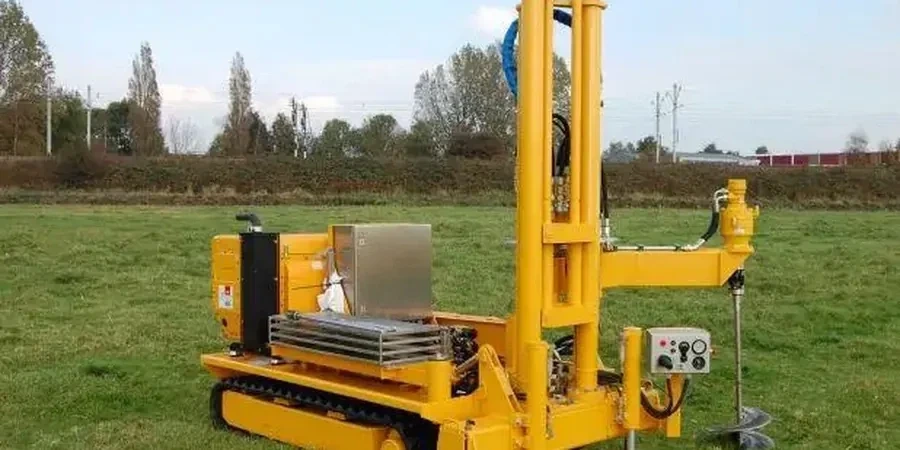
A CPT log gives you a continuous, undisturbed profile of cone resistance and pore pressure — essential for Leeds' layered glacial till and alluvium.
Scope of work in Leeds
Critical ground factors in Leeds
A 15-storey student accommodation block near the Leeds Inner Ring Road was founded on CFA piles. The design assumed uniform stiff till. After a heavy rain event, the contractor hit a 3-metre sand channel that had no expression at surface. The pile rig refused, and two piles had to be re-cored. We ran CPT soundings across the site and found three buried channels. The client redesigned the pile layout. No more rejected piles. That is why we push CPT before piling in Leeds.
This service complements our laboratory testing work for a complete project analysis.
Our services
We offer a full suite of CPT-related solutions tailored to Leeds ground conditions.
Mechanical CPT (15 cm² cone)
Standard cone penetration test with tip resistance, sleeve friction, and pore pressure. Suitable for soft to firm clays, sands, and till. Push depths up to 25 m.
Seismic CPT (SCPT)
Shear wave velocity measurement at 1 m intervals using geophones embedded in the push rods. Used for site class determination and liquefaction analysis.
CPT with pore pressure dissipation
Dissipation tests at target depths to estimate coefficient of consolidation (ch) and hydraulic conductivity. Essential for clay layers in Leeds.
CPT-based soil classification
Real-time interpretation per Robertson 1990 chart. Delivered as a continuous soil behaviour type log alongside the raw data.
FAQ
How deep can CPT push in Leeds ground conditions?
Typically 15 to 25 metres. In soft alluvium or till we can reach 25 m. In dense sandstone or gravel the cone may refuse earlier. We always assess refusal risk before mobilising.
What is the difference between CPT and SPT?
CPT gives a continuous profile of cone resistance and pore pressure. SPT is a discrete blow-count test every 1.5 m. CPT is faster, less disruptive, and provides higher resolution data for layered soils like those in Leeds.
How much does a CPT test cost in Leeds?
The typical price range is £120 to £210 per linear metre. This includes mobilisation, pushing, and a certified report. Volume discounts apply for large developments.
Can CPT detect buried channels in glacial till?
Yes. The cone resistance drops sharply in sand channels compared to stiff till. We identify these zones in real time. In Leeds we have found buried channels up to 5 m deep that were invisible to boreholes.