The difference between a hillside property in Headingley and a low-lying site near the River Aire is not just elevation — it is the soil itself. Headingley sits on glacial till and sandstone, relatively stable. Down by the Aire, thick alluvial deposits and soft clays dominate. In both cases, debris flow analysis reveals how water, slope angle, and soil type interact. We combine field inspection with laboratory testing to model run-out paths and trigger thresholds. A complementary permeability test helps quantify subsurface drainage conditions before any run-out modelling begins. That data is critical for setting realistic hazard boundaries in Leeds.
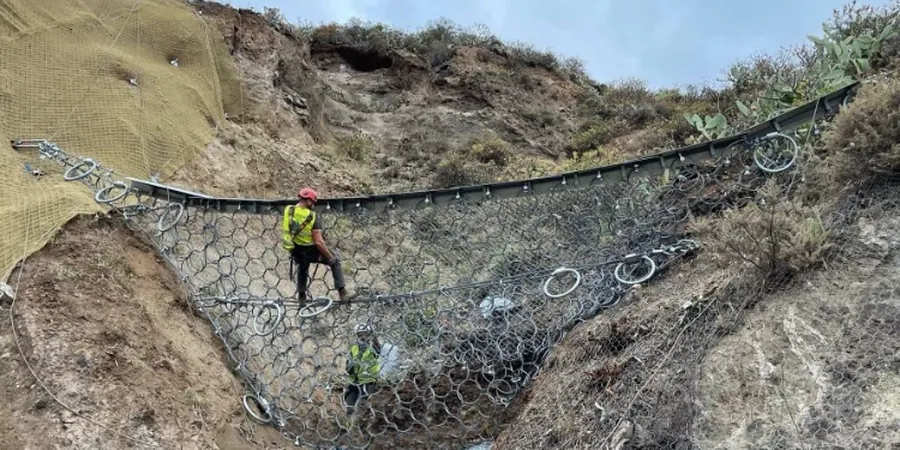
Debris flows in the Pennine foothills move fast — modelling the trigger threshold is the only way to buy time for mitigation.
Scope of work in Leeds
Critical ground factors in Leeds
The bedrock beneath Leeds is predominantly Carboniferous Millstone Grit and Coal Measures, overlain by glacial till and river terrace deposits. That sequence creates a classic failure scenario: permeable sandstone over low-permeability clay. After prolonged rain, water builds up at the interface, reducing effective stress. The steep slopes around Kirkstall and Horsforth have recorded multiple shallow translational slides since the 1970s. Debris flow analysis in Leeds must account for these layered profiles. Ignoring the clay barrier is the most common mistake — it turns a wet slope into a moving one overnight.
This service complements our laboratory testing work for a complete project analysis.
Our services
We offer two core service lines for debris flow analysis in Leeds. Both are delivered by chartered engineers with UKAS-accredited laboratory support.
Field reconnaissance and hazard mapping
Walkover surveys on the steep flanks of the Aire Valley, identifying tension cracks, seepage zones, and past failure scars. We produce 1:10,000 hazard maps using empirical run-out models (Hungr, 1995) calibrated for Pennine topography.
Laboratory testing for debris flow soils
Direct shear and triaxial tests on undisturbed samples from the Leeds area. We measure residual shear strength and pore pressure response under saturated conditions. All tests follow BS 1377 and BS 1377-7.
FAQ
What is the difference between a debris flow and a landslide?
A landslide involves a coherent mass of soil or rock sliding along a defined shear surface. A debris flow is a fast-moving mixture of soil, water, and debris that behaves like a viscous fluid. In Leeds, shallow translational slides on steep till slopes can transition into debris flows when water content exceeds 30%. Our analysis identifies the moisture threshold for each site.
How much does a debris flow analysis cost in Leeds?
A typical site-specific debris flow analysis in Leeds ranges between £1,090 and £3,720. The final cost depends on slope complexity, access conditions, and whether laboratory testing is required. We supply a fixed-price quotation after a site visit.
Do I need planning permission before a debris flow study?
Not for the study itself. Ground investigation works in Leeds may require prior approval from the local authority if they involve drilling or excavation on sensitive slopes. We handle all Section 199 and landowner consents on your behalf. The analysis report is usually submitted as part of a planning application for new development near steep ground.
How long does a debris flow analysis take?
A standard study takes three to four weeks from site visit to final report. If laboratory testing (direct shear, triaxial) is required, add one to two weeks. For urgent sites near the Otley Chevin or Meanwood Valley, we can expedite the field survey within five working days.