Leeds sits on a varied geology of Carboniferous Millstone Grit and Coal Measures, with glacial till covering much of the city centre. The Aire Valley corridor alone has seen over 15 major infrastructure projects in the last decade, each requiring strict compaction control. Our team has been running field density tests using the sand cone method across Leeds for years — it remains the most direct way to verify that placed fill meets the specified relative compaction. Before any load-bearing layer is approved, we correlate these results with a laboratory permeability test when drainage is critical, or a direct shear test to confirm shear strength parameters for slope stability.
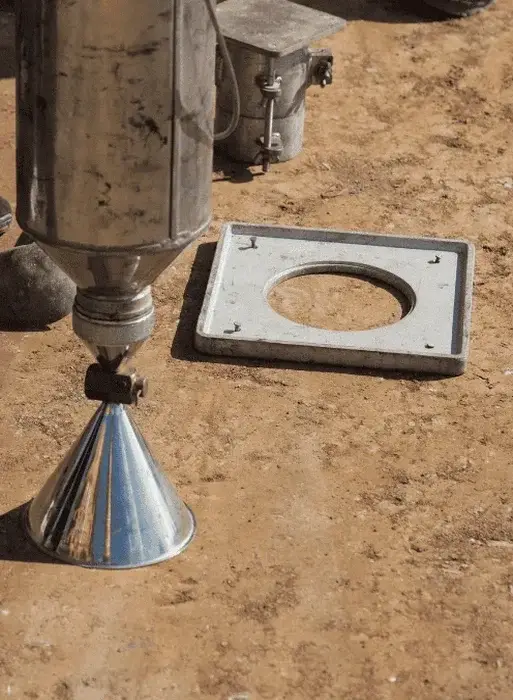
On Leeds' glacial tills, the sand cone method delivers compaction verification within 1% of nuclear gauge accuracy — at a fraction of the cost.
Scope of work in Leeds
Critical ground factors in Leeds
A recent residential development off Kirkstall Road ran into trouble when the contractor relied solely on nuclear gauge readings without sand cone verification. The glacial till had variable moisture pockets that the nuclear gauge averaged out, leading to three failed plate load tests. We were called in to run sand cone tests at 12 locations — every one showed compaction below 92% of Proctor. The client had to strip and re-compact a 300 mm layer across half the site, adding two weeks to the programme. That cost could have been avoided with proper field density control from day one.
This service complements our laboratory testing work for a complete project analysis.
Our services
We offer a full suite of compaction control solutions in Leeds, all backed by our UKAS-accredited laboratory.
Sand Cone Field Density Testing
In-situ density determination using the sand replacement method per BS 1377-9. We handle fills, subgrades, trench backfill, and capping layers across Leeds construction sites.
Proctor Compaction Reference Testing
Standard and modified Proctor tests (BS 1377-4) to establish the maximum dry density and optimum moisture content for each material type before field density control begins.
Moisture Content & Density Reporting
Full laboratory determination of moisture content, bulk density, and dry density with a UKAS-accredited certificate. Results delivered digitally within 24 hours of sample arrival.
FAQ
How much does a field density test (sand cone) cost in Leeds?
A standard sand cone test in Leeds typically ranges from £80 to £120 per test, including the in-situ measurement and laboratory moisture content determination. Volume discounts apply for projects requiring 10 or more test locations.
What's the difference between sand cone and nuclear gauge for compaction testing?
The sand cone method measures actual volume and mass directly, making it the reference standard for dispute resolution. Nuclear gauges are faster but can be affected by soil chemistry and moisture gradients — on Leeds' glacial tills we often recommend sand cone as the primary method for contract compliance.
How many sand cone tests are needed per area of fill?
For earthworks in Leeds, the general rule is one test per 1,000 m² per lift, with a minimum of three tests per defined area. Trench backfill typically requires one test per 50 linear metres. Your geotechnical specification should define the frequency.
Can the sand cone method be used on gravelly or coarse fills?
Yes, but only if the maximum particle size does not exceed 50 mm. For coarser materials common in West Yorkshire quarry fills, we recommend the replacement method using a larger test hole (up to 300 mm diameter) or the water replacement method per BS 1377-9.