Leeds sits on a mix of glacial till and alluvial deposits, with the River Aire cutting through the city centre. That means high groundwater and compressible soils are common, especially in the Holbeck and Hunslet areas. For any large-scale fill project or embankment here, pre-consolidation is critical. Prefabricated vertical drain (PVD) design shortens the drainage path and accelerates settlement. It saves months of waiting time on soft ground. We always cross-check PVD spacing with permeability testing in the lab to get the dissipation rates right. Without that calibration, the spacing guess can be wildly wrong.
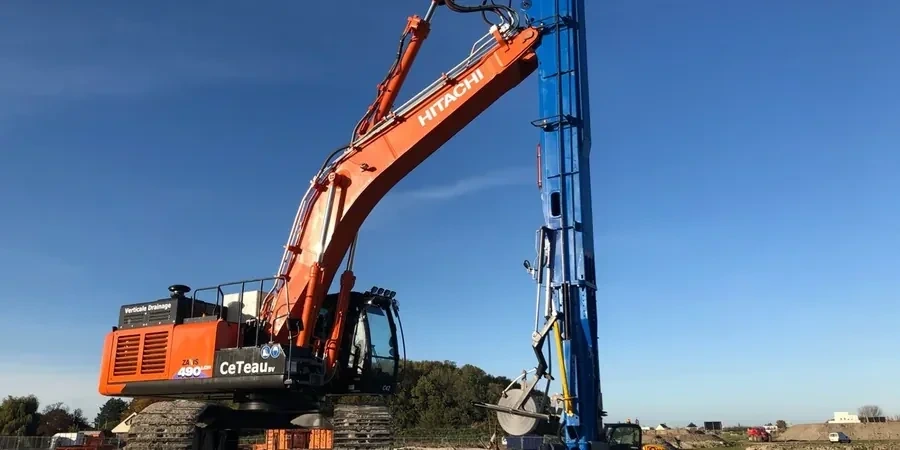
PVD design in Leeds must account for lateral variability in glacial till — one borehole can show sand lenses, the next pure clay.
Scope of work in Leeds
Critical ground factors in Leeds
Leeds expanded rapidly during the Industrial Revolution, with mills and warehouses built directly on soft alluvial flats. Many of those old foundations are still there, buried under later fill. When a new development excavates or surcharges that ground, the old compressible layers reactivate. PVD design helps drain those layers and stabilise the site before construction. We have seen cases where a 2-metre surcharge without drains took over two years to settle. With properly spaced PVDs, that dropped to six months. The cost of waiting is often higher than the drain installation itself.
This service complements our laboratory testing work for a complete project analysis.
Our services
We offer two complementary PVD design solutions for Leeds projects, each tailored to the site conditions and programme.
PVD spacing and layout design
Full design of triangular or square drain patterns, including mandrel selection, smear zone correction, and consolidation time estimates. We deliver a dwg-ready layout and a settlement prediction report.
PVD combined with preload or vacuum consolidation
Integration of PVDs with surcharge fill or vacuum systems to accelerate consolidation further. We size the preload height and vacuum pressure, and monitor pore pressure during the installation phase.
Watch how it works
FAQ
What is the typical PVD spacing for soft clay in Leeds?
For most Leeds soft clays and silts, spacing ranges from 1.2 m to 2.0 m on a triangular grid. The exact value depends on the coefficient of consolidation and the target degree of consolidation within the project timeline. We run site-specific calculations.
How long does consolidation take with prefabricated vertical drains?
With properly designed PVDs, 90% consolidation typically occurs within 3 to 12 months in Leeds ground conditions, compared to 2–5 years without drains. The time depends on drain spacing, soil permeability, and surcharge load.
Do you need a ground investigation before designing PVDs?
Yes, absolutely. We need boreholes with undisturbed sampling, oedometer tests for consolidation parameters, and permeability data. A good ground investigation is the foundation of a reliable PVD design. Without it, spacing guesses lead to settlement problems.
What is the cost range for a PVD design in Leeds?
For a typical Leeds site, the design fee ranges between £670 and £1,840, depending on the number of boreholes, the complexity of the soil profile, and whether we include numerical modelling. This does not cover installation or monitoring costs.