Leeds sits on Carboniferous coal measures overlain by glacial till, but its urban soils hide a legacy of made ground and variable clay moisture regimes. The city's 131 rainy days per year and winter freeze-thaw cycles demand a rigid pavement design that accounts for frost heave potential and differential settlement under repeated loading. We combine subgrade CBR testing with jointed reinforced concrete slab analysis to keep industrial estates and distributor roads serviceable for decades. Before specifying slab thickness, we often run a clasificacion de suelos to map plasticity across the site and a subrasante-vial evaluation to confirm California Bearing Ratio values at field moisture content.
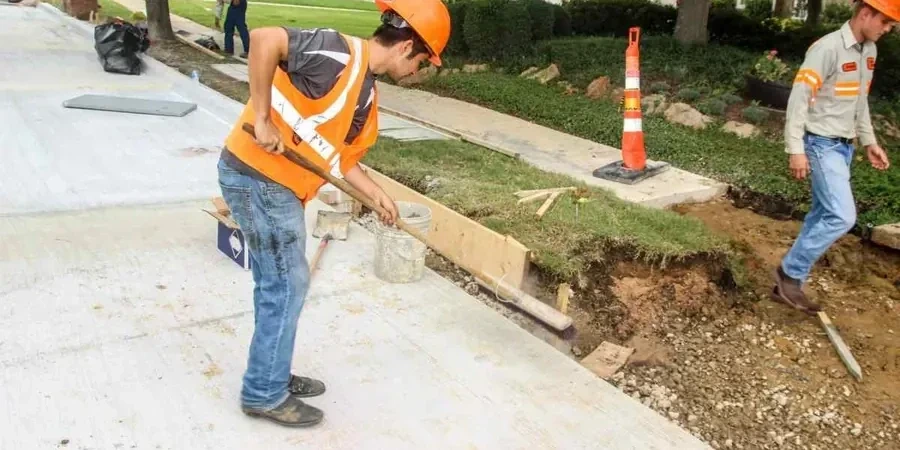
Leeds clay subgrades lose up to 40% of their bearing capacity when saturated; rigid pavement design must integrate drainage before the concrete is placed.
Scope of work in Leeds
Critical ground factors in Leeds
In Leeds, many times we find that historical mine workings and shallow coal seams create voids that undermine rigid pavement support. Without a ground investigation that includes trial pits and dynamic probing, a slab can crack within its first winter due to differential settlement. Another frequent issue is sulphate attack on concrete from pyritic shales in the Coal Measures; we always recommend a sulphate resistance class (SRC) specification when the ground chemistry indicates risk. Complementing the rigid pavement design with asentamiento-diferencial analysis helps identify critical zones before construction begins.
This service complements our laboratory testing work for a complete project analysis.
Our services
We deliver integrated rigid pavement design solutions that cover the full project lifecycle from ground investigation to construction support. Each service is tailored to Leeds geology and local authority requirements.
Subgrade Characterisation & CBR Testing
Field and laboratory California Bearing Ratio tests on undisturbed and remoulded samples, correlated with DCP and plate load tests to establish design k-values for Leeds sites.
Rigid Pavement Structural Design & Detailing
Slab thickness design, joint layout optimisation, and dowel/tie bar detailing in accordance with DMRB CS 226 and BS EN 1997-1:2004, including steel fibre concrete options.
Drainage & Frost Protection Strategy
Design of sub-base drainage layers, edge drains, and frost protection blankets to maintain subgrade strength through Leeds' wet winters and freeze-thaw cycles.
FAQ
What is the typical rigid pavement design life for industrial roads in Leeds?
For heavily trafficked industrial estates and HGV routes in Leeds, we design to a 40-year structural life with a 20-year maintenance interval for joint resealing and dowel bar retrofits. Lower-volume access roads can be designed for 20 years.
How does Leeds clay shrink-swell affect rigid pavement performance?
High-plasticity glacial till in Leeds can undergo volumetric changes of 8-12% with seasonal moisture variation. This movement induces edge curling and corner cracking in slabs. Our design incorporates a 150-200 mm granular capping layer and moisture control measures to decouple the slab from subgrade movement.
What is the cost range for a rigid pavement design report in Leeds?
A full rigid pavement design report including subgrade testing, structural calculations, and joint detailing typically ranges between £1,540 and £5,470 depending on site area, traffic classification, and the number of design sections. A preliminary desktop assessment starts from £850.
Do you include frost heave analysis in your rigid pavement design for Leeds?
Yes. Leeds lies in a region where ground freezing can reach 450 mm depth in severe winters. Our design checks frost susceptibility of the subgrade per TRL Report 529 and specifies 450-600 mm of frost-resistant material (Type 1 or 6F2) where needed to prevent slab uplift.