Leeds presents a striking contrast in ground conditions between the elevated sandstone ridges of Headingley and the deep alluvial deposits underlying Holbeck and the Aire Valley corridor. While the former offers competent bedrock at shallow depth, the latter contains saturated, loose sands and silts that are prime candidates for cyclic softening under seismic excitation. Although the UK is a low-seismicity region, the 2008 Market Rasen earthquake (M4.7) demonstrated that distant tremors can still trigger excess pore pressure in susceptible profiles. A thorough soil liquefaction analysis in Leeds therefore becomes essential when building on these valley-floor sediments, particularly for infrastructure projects requiring long-term deformation tolerance. Without it, designers risk underestimating post-shaking settlement or lateral spreading in areas where the water table sits within a few metres of the surface.
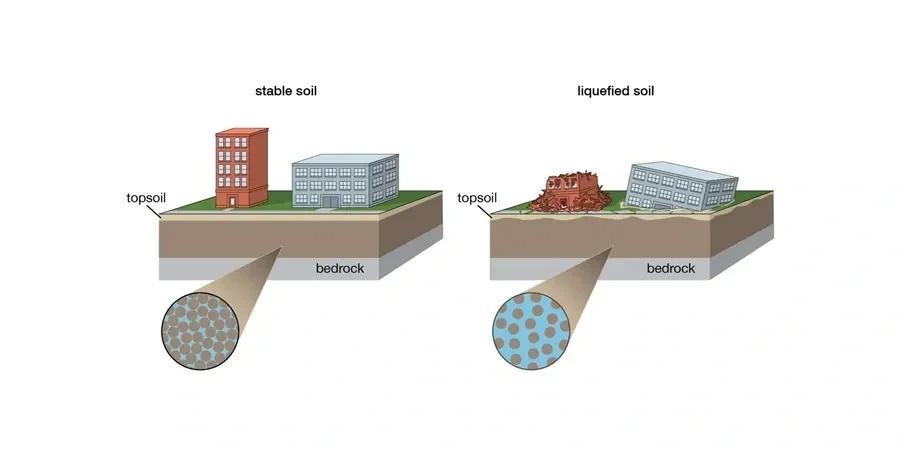
A factor of safety below 1.1 in the top 12 metres demands Improvement even for low-seismicity sites like Leeds.
Scope of work in Leeds
- N-value corrections for overburden and rod energy ratio following Seed & Idriss methodology
- Fines content adjustment using Atterberg limits from adjacent boreholes
- Cyclic stress ratio (CSR) calculation for the design earthquake magnitude
Critical ground factors in Leeds
Eurocode 7 (EN 1997-1:2004) Clause 3.2.3 requires that the design account for loss of strength due to pore pressure build-up in saturated granular soils. In Leeds, this is especially relevant because the Aire floodplain contains interbedded sands and silts with natural water contents close to the liquid limit. A magnitude 5 earthquake centred beneath the North Sea could induce a CSR that exceeds the cyclic resistance ratio (CRR) in layers where the SPT blow-count drops below 12. The consequence is not just bearing failure but differential settlement that fractures rigid pavements or distorts piled foundations connected by ground beams. Our analysis flags these zones so that mitigation measures — such as deep soil mixing — can be targeted precisely at the critical depth intervals.
This service complements our laboratory testing work for a complete project analysis.
Our services
Our soil liquefaction analysis in Leeds covers the full workflow from field data acquisition to engineering interpretation. The three core solutions below are tailored to the specific ground conditions encountered across the city's glacial and alluvial terrains.
SPT-Based Cyclic Resistance Assessment
Standard Penetration Tests performed to BS EN ISO 22476-3 with automatic hammer energy measurement. Corrections applied for rod length, borehole diameter, and liner presence. The resulting N60 values feed into the Youd-Idriss CRR curves to produce depth-specific factors of safety.
Shear-Wave Velocity Profiling (MASW)
Multichannel analysis of surface waves deployed along linear arrays up to 70 metres in length. The VS30 profile classifies the site per ASCE 7 and provides an independent check on the SPT-based CRR estimate. Particularly useful where gravel layers prevent reliable SPT sampling.
Post-Liquefaction Settlement Analysis
Volumetric strain calculations using the Tokimatsu & Seed method for clean sands and the Ishihara & Yoshimine approach for silty sands. Output includes settlement contours and differential movement estimates for foundation design verification.
FAQ
How much does a soil liquefaction analysis in Leeds cost?
The typical cost for a complete liquefaction assessment including SPT fieldwork, MASW survey, and engineering interpretation ranges between £2,010 and £3,630. The final figure depends on the number of boreholes, the depth of investigation, and whether laboratory cyclic triaxial testing is required.
Which areas of Leeds have the highest liquefaction risk?
The alluvial floodplain of the River Aire, particularly around Holbeck, Stourton, and the Leeds Liverpool Canal corridor, contains loose to medium-dense sands with water tables at 2 to 4 metres depth. These conditions yield the lowest factors of safety in the city. The elevated areas on Millstone Grit, such as Headingley and Roundhay, present negligible risk.
What is the difference between CRR and CSR in liquefaction analysis?
The cyclic resistance ratio (CRR) represents the capacity of the soil to withstand cyclic loading without developing excessive pore pressure. It is derived from SPT N-values, fines content, and shear-wave velocity. The cyclic stress ratio (CSR) is the demand imposed by the design earthquake, calculated from peak ground acceleration, magnitude scaling, and stress reduction factors. Liquefaction occurs when CSR exceeds CRR.
Can liquefaction occur in Leeds given the UK's low seismicity?
Yes, it can. The 2008 Market Rasen earthquake (M4.7) generated ground accelerations of 0.04g in Leeds, which is sufficient to trigger liquefaction in very loose, saturated sands with N-values below 8. Even distant earthquakes in the North Sea or the Dover Straits can produce the cyclic loading needed to initiate pore pressure build-up in susceptible profiles.
What Improvement methods are recommended for liquefiable soils in Leeds?
For sites where the factor of safety falls below 1.1, common mitigation strategies include deep soil mixing to create stiff columns that reduce cyclic shear strains, stone columns for drainage and densification, and vibro-compaction in clean sands. The choice depends on the depth of the liquefiable layer, the presence of fines, and the proximity to existing structures.