Leeds sits on a varied geology – from glacial tills in the north to alluvial deposits along the River Aire. With a population of over 800,000, the city has seen rapid urban development. Every foundation we design starts with an SPT (Standard Penetration Test) to determine soil strength at depth. We follow BS 5930 and Eurocode 7 (EN 1997-1:2004) for all field work. In areas like Kirkstall or Holbeck, where old industrial fill is common, the SPT is essential to avoid costly surprises. We combine it with a masw vs30 survey to map shear-wave velocity profiles, giving a complete picture of ground stiffness.
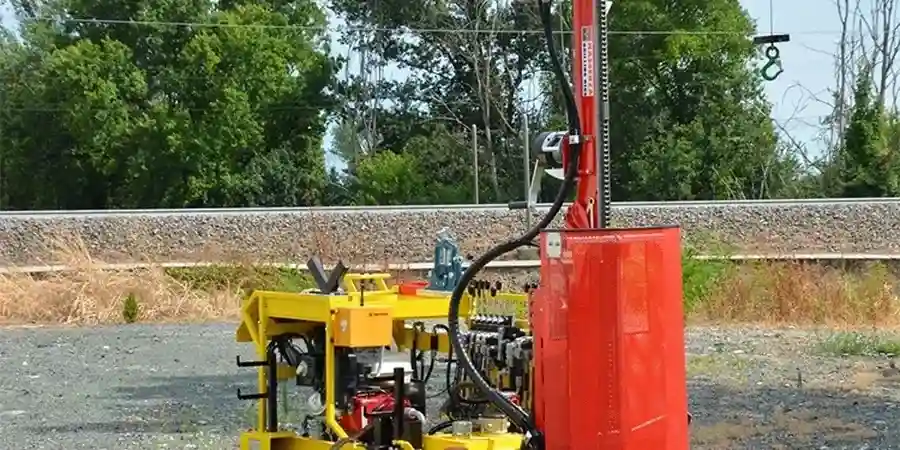
In Leeds, a single SPT blow count below 10 in glacial till can signal loose ground – we flag it immediately.
Scope of work in Leeds
Critical ground factors in Leeds
We use a truck-mounted rig with automatic hammer system for SPT in Leeds. On tight city sites, like those near the Leeds General Infirmary, we switch to a compact tracked rig. The hammer falls with a precise energy of 60-70% of theoretical free fall. Any deviation in energy, especially on old manual trip hammers, leads to unreliable N-values. In Leeds, where glacial tills can contain cobbles, a dull or bent spoon gives false low counts. We inspect and calibrate the equipment daily. Ignoring this step risks overestimating bearing capacity by 30% or more. That is how foundations fail.
This service complements our laboratory testing work for a complete project analysis.
Our services
We offer two complementary solutions to match your project stage and budget.
Standard SPT (N-value) – On-site logging
Full SPT at 1.0 m or 1.5 m intervals, with continuous soil description and sample recovery. Suitable for residential and commercial projects up to 25 m depth. Includes energy measurement and automatic hammer calibration.
SPT with DCPT (Dynamic Cone Penetrometer) correlation
SPT combined with a 10 kg DCPT to obtain continuous N-values between standard tests. Ideal for identifying thin weak layers in Leeds alluvial deposits or variable fill. Results are cross-checked with laboratory index tests.
FAQ
What is the typical cost of an SPT in Leeds?
A standard SPT to 10 m depth in Leeds costs between £420 and £590, depending on access, ground conditions, and number of tests. This includes on-site logging, sample recovery, and a factual report. Volume discounts apply for multiple boreholes.
How deep can an SPT go in Leeds ground conditions?
In glacial tills or dense sands we typically reach 15 m to 25 m. Below that, refusal occurs due to high blow counts or cobbles. We always pre-assess using existing records from the British Geological Survey before mobilising.
Do I need SPT if I already have trial pits?
Trial pits show soil type but not strength at depth. SPT provides a direct measure of density and stiffness, which is critical for foundation design. In Leeds, where fill can be loose, SPT often reveals lower bearing values than assumed.
Can SPT detect liquefaction risk in Leeds?
Yes, SPT blow counts are the primary input for liquefaction assessment using the Youd-Idriss (2001) method. Leeds has low seismicity, but in loose saturated sands along the River Aire, we always check. N-values below 10 in these zones trigger further analysis.
How do you ensure SPT accuracy on site?
We use automatic hammers with energy measurement, calibrate the spoon daily, and follow BS EN ISO 22476-3 strictly. Our team holds UKAS accreditation for field testing. All results are checked by a chartered geotechnical engineer before reporting.